Search is evolving beyond traditional keyword matching. Google and modern AI-powered search systems are becoming better at understanding people, businesses, brands, products, services, places, topics, and the relationships between them.
This is why Entity SEO Optimization has become an important part of a modern search strategy.
Entity SEO Optimization helps search engines understand who you are, what your business does, what you offer, what you are known for, and how your brand connects to relevant topics. Instead of optimizing your website only around keywords, an effective Entity SEO Optimization strategy builds a stronger and more recognizable digital identity for your business.
What Is Entity SEO Optimization?
Entity SEO Optimization is the process of helping search engines understand a business, person, brand, product, service, or organization as a distinct real-world entity.
For example, a business may be connected with several entities:
Brand → Founder → Services → Location → Industry → Topics → Products → Expertise
When these relationships are clearly represented across your website and trusted sources around the web, search engines can develop a better understanding of your brand.
Traditional SEO asks:
“Which keywords should this page rank for?”
Entity SEO Optimization asks:
“What does this business represent, what is it known for, and how are its important entities connected?”
This shift from keyword-focused SEO to entity-based SEO and semantic search optimization is becoming increasingly important as search technology continues to evolve.
Why Entity SEO Optimization Matters for Modern Search
Google does not rely only on exact keyword matches to understand a website. Modern search systems consider context, meaning, relationships, relevance, authority, and many other signals.
At the same time, AI-powered search experiences are changing how users discover information.
A strong Entity SEO Optimization strategy can help your website establish clearer signals around your:
- Brand identity
- Business expertise
- Products and services
- People and authors
- Locations
- Industry
- Important topics
- Professional relationships
The goal of Entity SEO Optimization is to create a consistent and trustworthy digital identity that can be understood across search engines and AI-powered discovery systems.
Entity SEO Optimization vs Traditional Keyword SEO
Keywords are still an important part of SEO. However, keywords alone do not completely explain what a business is or why it should be considered authoritative.
Consider the keyword “SEO consultant.”
A search engine needs more information to understand whether a website represents an individual consultant, an agency, an SEO training provider, a software company, or an informational publication.
This is where Entity SEO Optimization becomes valuable.
Entity SEO Optimization connects keywords with meaning, context, expertise, and relationships. It allows your content strategy to move beyond repeating keywords and instead build comprehensive topical coverage around your core expertise.
This combination of keyword SEO, semantic SEO, and entity-based SEO creates a stronger foundation for sustainable search visibility.
Our Entity SEO Optimization Process
1. Entity Discovery & Research
We begin by identifying the important entities associated with your business.
These may include your:
- Brand
- Founder or key people
- Products
- Services
- Business locations
- Industry
- Core topics
- Supporting topics
- Professional profiles
We analyze how these entities currently appear online and identify opportunities to strengthen their identity and relationships.
This initial research provides the foundation for an effective Entity SEO Optimization strategy.
2. Entity Identity Optimization
Consistency matters when building a recognizable digital entity.
Your business name, descriptions, services, contact information, location, profiles, and other important information should be represented accurately across your website and relevant platforms.
We optimize important website elements such as the About page, service pages, author information, business information, contact details, and brand descriptions to create stronger entity signals.
Through Entity SEO Optimization, these signals can be organized into a clearer and more consistent digital identity.
3. Semantic & Entity-Rich Content
High-quality Entity SEO Optimization requires more than creating pages around isolated keywords.
We develop entity-rich content that naturally covers related concepts, questions, subtopics, entities, and search intent.
For example, a Local SEO website may need supporting content around:
Google Business Profile, local citations, NAP consistency, reviews, local search intent, local rankings, maps, schema markup, and local link building.
These connected topics help establish topical authority and provide search engines with additional context about your expertise.
A well-planned Entity SEO Optimization strategy connects these topics rather than treating every keyword as an isolated opportunity.
4. Structured Data & Schema Markup
Structured data provides machine-readable information that can help search engines interpret important information on your website.
Depending on the website, relevant schema types may include:
- Organization
- Person
- LocalBusiness
- Service
- Product
- Article
- Breadcrumb
- WebSite
Schema markup is not a guaranteed ranking factor or shortcut. Its value comes from helping search engines understand and classify information more clearly when implemented accurately.
As part of Entity SEO Optimization, structured data should accurately represent the entities and relationships already supported by your website.
5. Building Entity Relationships
A strong entity does not exist in isolation.
Your brand may be connected to people, services, locations, products, publications, organizations, and industry topics.
We build a logical entity relationship structure across your website and relevant external sources.
Internal linking also plays an important role by connecting your main service pages with supporting resources and related topics.
This creates a more organized website architecture for both users and search engines and strengthens the overall Entity SEO Optimization framework.
6. Authority & Trust Signals
Entity SEO Optimization works best when supported by genuine authority and trust.
We focus on strengthening relevant signals through:
- High-quality content
- Author information
- Expert profiles
- Relevant mentions
- Industry publications
- Business directories
- Reviews
- Professional profiles
- Original research
- Case studies
- Consistent business information
The objective is not to create artificial signals. It is to establish a credible and recognizable presence across the web.
Entity SEO Optimization for AI Search, AEO & GEO
The future of search is increasingly conversational and AI-driven.
Google AI-powered search features and other generative search systems need to understand entities and relationships when selecting information to surface in answers.
This makes Entity SEO Optimization, AI Search Optimization, Answer Engine Optimization (AEO), and Generative Engine Optimization (GEO) closely connected.
When your website clearly communicates your expertise, services, identity, topical relationships, and supporting evidence, you create a stronger foundation for visibility in modern search experiences.
A comprehensive Entity SEO Optimization strategy can therefore become an important part of an overall AI Search Optimization strategy.
Entity SEO Optimization and E-E-A-T
Entity SEO Optimization also supports a stronger E-E-A-T framework: Experience, Expertise, Authoritativeness, and Trustworthiness.
Your website should make it easy for users and search systems to understand:
Who are you?
What do you know?
What does your business do?
Why should people trust you?
What evidence supports your expertise?
Detailed author profiles, genuine experience, original content, transparent business information, case studies, reviews, and authoritative references can all contribute to a stronger digital identity.
Who Can Benefit From Entity SEO Optimization?
Entity SEO Optimization can benefit almost any organization that wants to establish a recognizable online presence, including:
- Personal brands
- SEO consultants
- Digital marketing agencies
- Local businesses
- E-commerce brands
- SaaS companies
- Professional service businesses
- Authors and speakers
- Publishers
- International businesses
Whether you are building a personal brand or growing an established company, Entity SEO Optimization can help create a stronger foundation for long-term search authority.
Build Your Search Entity. Strengthen Your Authority.
Entity SEO Optimization is more than adding keywords to a website. It is about creating a clear, consistent, and trustworthy digital identity that search engines and AI systems can understand.
By combining Entity SEO Optimization, semantic SEO, topical authority, structured data, schema markup, internal linking, E-E-A-T, and AI search optimization, your business can build stronger relationships between your brand and the topics that matter most to your audience.
The future of search belongs to brands that are not only visible, but also understood, trusted, and recognized.
If you want to build stronger search authority and prepare your website for Google and AI-powered search, Entity SEO Optimization should be an essential part of your long-term SEO strategy.
Ready to Build Your Search Authority?
Let’s turn your website from a collection of keywords and pages into a recognizable search entity with a clear digital identity, stronger topical authority, and a foundation built for the future of search.
With a strategic Entity SEO Optimization approach, your brand can create clearer connections between its business identity, expertise, services, content, people, and important industry topics.

In today’s digital marketplace, Local SEO for Small Business consumers no longer flip through yellow pages or drive aimlessly to find nearby services. Instead, they whip out their smartphones, type a quick query like “best plumber near me” or “coffee shop open now,” and choose from the top results. If your storefront or service area isn’t appearing at the very top of those search engine results, you are handing paying customers directly to your competitors. Implementing a robust strategy for local SEO in small business is no longer optional—it is the ultimate engine for sustainable growth, foot traffic, and community authority.
Understanding the Landscape of Local SEO in Small Business
Before diving into advanced tactics, we must define what makes local SEO in small business unique compared to traditional global or national search engine optimization. While standard SEO focuses on ranking for broad keywords worldwide, local SEO optimizes your digital footprint so that search engines like Google display your business prominently when nearby users look for your specific offerings.
Why Local Search Matters for Mom-and-Pop Shops
Statistics consistently show that a massive percentage of local searches result in an immediate store visit or phone call within 24 hours. When a user searches for local SEO in small business solutions or looks for a physical service provider, their purchase intent is remarkably high. They aren’t just browsing; they are ready to buy, book an appointment, or walk through your doors. By focusing on local SEO in small business, you level the playing field against massive national conglomerates, capturing high-converting traffic right in your backyard.
Core Pillars of Local SEO in Small Business Success
To achieve top rankings in local search result pages (SERPs) and the coveted Google Local Map Pack, you need a multi-faceted approach. Let’s break down the foundational pillars that drive local SEO in small business visibility. 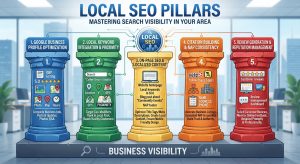
+——————————————————-+
| LOCAL SEO PILLARS |
+——————————————————-+
| 1. Google Business Profile Optimization |
| 2. Local Keyword Integration & Proximity |
| 3. On-Page SEO & Localized Content |
| 4. Citation Building & NAP Consistency |
| 5. Review Generation & Reputation Management |
+——————————————————-+
1. Optimizing Your Google Business Profile (GBP)
Your Google Business Profile is the absolute cornerstone of any successful campaign for local SEO in small business. Formerly known as Google My Business, this free tool controls how your enterprise appears on Google Maps and local search panels.
- Claim and Verify: Ensure you own your listing and that all physical addresses or service areas are correctly verified.
- Complete Categories: Select a primary category that best defines your core offering, followed by precise secondary categories.
- Operating Hours & Attributes: Keep your hours updated, especially during holidays, and add relevant attributes (e.g., wheelchair accessible, woman-owned).
- High-Resolution Visuals: Regularly upload photos of your team, products, storefront, and completed projects to build trust.
2. Mastering NAP Consistency and Local Citations
NAP stands for Name, Address, and Phone number. Search engines crawl the web to cross-reference your business details across various directories, review sites, and social media platforms.
For optimal local SEO in small business performance, your NAP data must remain 100% identical everywhere it appears online. If your website lists “123 Main Street” while Yelp lists “123 Main St. Suite 4,” search engine algorithms get confused, diluting your local authority and harming your rankings.
Keyword Strategy: Integrating Local SEO in Small Business Terms
A successful keyword strategy requires understanding user intent and geographic modifiers. When executing local SEO in small business campaigns, you must target terms that combine your industry service with your target city, neighborhood, or region.
Finding the Right Local Keywords
Instead of targeting ultra-broad phrases like “marketing agency,” focus your local SEO in small business efforts on hyper-targeted variations such as “digital marketing agency in Austin TX” or “affordable web design for small businesses in downtown Austin.”
- Geo-Modifiers: Always include city names, zip codes, and regional landmarks in your content.
- Long-Tail Phrases: Answer specific questions your local customers are asking.
- Voice Search Optimization: People phrasing queries into Siri or Google Assistant often use conversational language, making natural phrasing essential for local SEO in small business growth.
Technical and On-Page Optimization for Local Dominance
Once your foundational profiles and keywords are aligned, you must optimize your website’s internal architecture to support your local SEO in small business objectives.
Structuring Your Website for Local Search
Every service area or physical location you operate should ideally have its own dedicated landing page. Avoid cramming multiple cities onto one generic page.
- Title Tags and Meta Descriptions: Ensure your primary term—local SEO in small business—and your target location appear naturally within your title tags and meta descriptions.
- Schema Markup: Implement LocalBusiness schema markup code on your website. This structured data helps search engine crawlers easily identify your business address, operating hours, geo-coordinates, and customer service contacts.
- Mobile-First Responsiveness: Most local searches happen on mobile devices while users are on the move. Fast loading speeds and seamless mobile navigation are critical requirements for local SEO in small business triumph.
Generating Reviews and Building Local Authority
Trust is a major ranking factor in modern search algorithms. Search engines reward businesses that have active, positive engagement from real local customers.
How Reviews Fuel Local Rankings
Encouraging satisfied clients to leave positive reviews on your Google Business Profile directly boosts your click-through rate and signals high quality to search crawlers.
- Prompt Follow-Ups: Send automated or personal follow-up emails shortly after a service is rendered, inviting clients to share their feedback.
- Professional Responses: Always reply to both positive and negative reviews promptly and professionally. This demonstrates active management and genuine customer care, reinforcing the effectiveness of your local SEO in small business roadmap.
- Local Link Building: Partner with nearby businesses, sponsor community events, or collaborate with local bloggers to earn high-quality backlinks from regional websites.
Measuring Success and Tracking Key Performance Indicators
You cannot improve what you do not measure. To ensure your investments in local SEO in small business strategies are paying off, track the right analytics metrics over time.
Essential Metrics to Monitor
- Map Pack Impressions and Views: See how often your Google Business Profile appears in local map results.
- Direction Requests and Phone Calls: Track direct actions taken straight from your listing.
- Organic Traffic Growth: Use tools like Google Analytics to monitor visitors landing on your local service pages.
- Keyword Rankings: Keep an eye on how your target phrases move up the rankings in your specific geographic target zones.
Conclusion
Mastering local SEO in small business environments takes patience, consistency, and a clear understanding of what local consumers and search engines desire. By claiming your Google Business Profile, maintaining strict NAP consistency, optimizing your website pages with localized content, and earning glowing customer reviews, you can capture high-intent traffic and secure long-term market dominance in your community. Start implementing these proven strategies today and watch your local customer base expand exponentially.
Frequently Asked Questions
Your Google Business Profile optimization and proximity to the searcher are typically considered the most vital components for ranking well in local pack results.
How long does it take to see results from local SEO?
Most small businesses begin noticing measurable improvements in visibility and foot traffic within 3 to 6 months of consistent optimization and citation building.
Do I need a physical storefront to do local SEO?
No. Service-area businesses (such as plumbers, electricians, and mobile cleaners) can successfully optimize their listings by defining specific service radii rather than displaying a public storefront address.
Search engine optimization is no longer only about keywords, backlinks, technical optimization, and search volume. Modern search systems are increasingly focused on whether content is genuinely useful, reliable, original, and created by people or organizations that understand the subject.
This is where E-E-A-T in SEO becomes important.
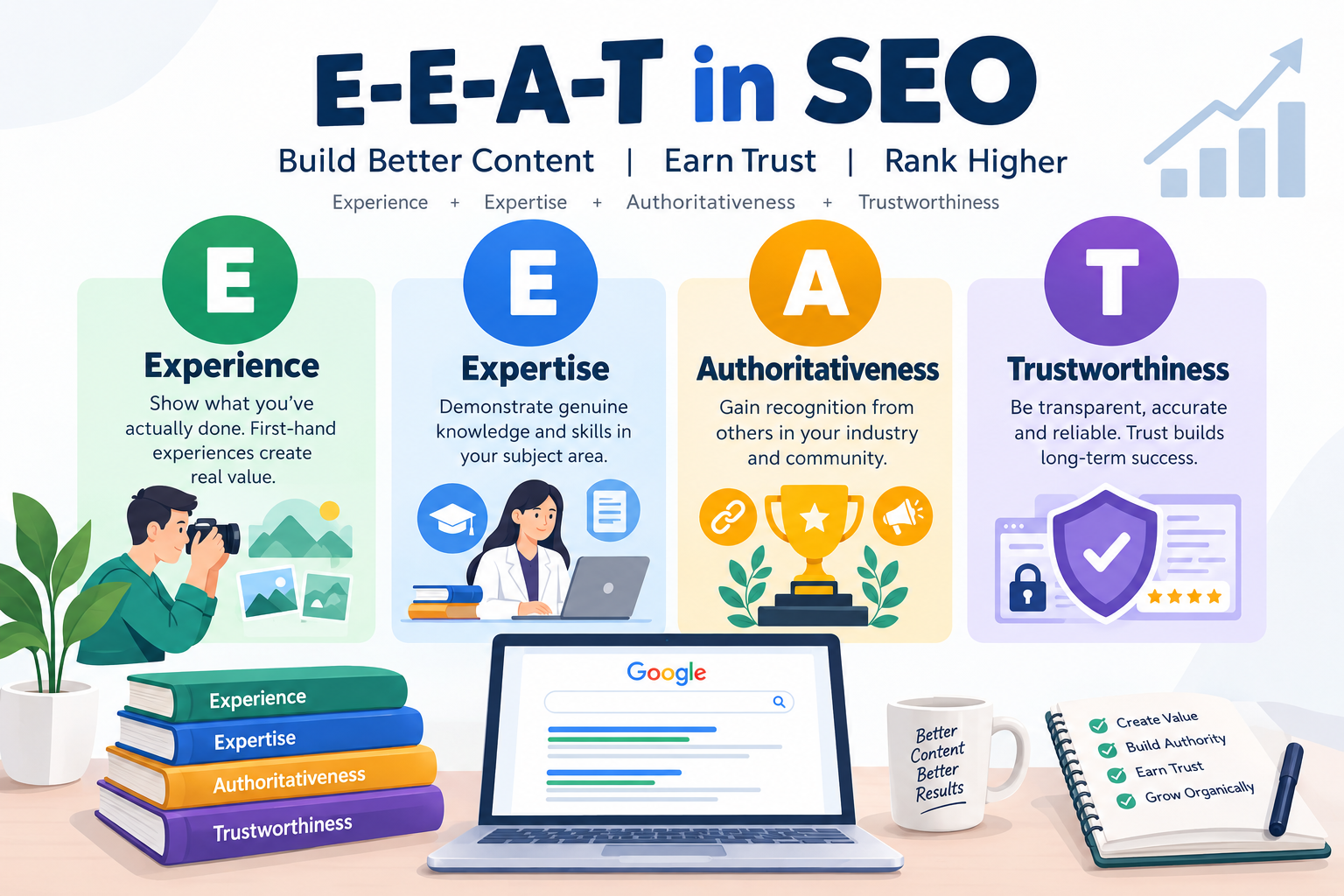
E-E-A-T stands for Experience, Expertise, Authoritativeness, and Trustworthiness. Google introduced the additional “E” for Experience to its quality rater guidelines in 2022, emphasizing the importance of first-hand experience alongside expertise, authority, and trust.
For businesses, bloggers, publishers, ecommerce websites, and SEO professionals, understanding E-E-A-T can help create stronger content and a more credible online presence.
What Is E-E-A-T in SEO?
E-E-A-T in SEO refers to the signals and qualities that help demonstrate that a website, author, business, or piece of content is experienced, knowledgeable, authoritative, and trustworthy.
The four components are:
- Experience – Has the creator actually experienced or used what they are discussing?
- Expertise – Does the creator demonstrate knowledge and skill in the subject?
- Authoritativeness – Is the creator or website recognized as a reliable source?
- Trustworthiness – Can users trust the information, business, website, and claims?
Google’s guidance emphasizes that trust is the most important aspect of E-E-A-T, while the other elements can contribute to establishing that trust.
However, an important distinction is necessary: E-E-A-T itself is not a specific ranking factor. Google uses many signals within its automated systems to identify helpful, reliable content that demonstrates these qualities.
Why Is E-E-A-T Important in SEO?
The internet contains millions of pages covering the same subjects. Simply publishing another article targeting the same keyword is unlikely to create meaningful differentiation.
Google’s systems aim to prioritize helpful and reliable information created primarily for people rather than content produced mainly to manipulate search rankings.
This makes E-E-A-T in SEO particularly valuable for websites competing in crowded search results.
Strong E-E-A-T can help a website demonstrate:
- Real-world knowledge
- Subject-matter expertise
- Brand credibility
- Author credibility
- Reliable information
- Original insights
- Transparent business information
- Better user confidence
For sensitive topics involving health, finances, safety, or major life decisions, Google places even greater importance on strong E-E-A-T signals. These topics are commonly referred to as YMYL — Your Money or Your Life.
The Four Elements of E-E-A-T 
1. Experience
Experience is the first “E” in E-E-A-T.
It focuses on whether content demonstrates first-hand or practical experience with the topic.
For example, imagine someone writes:
“I tested five SEO tools for six months and compared their keyword databases, reporting features, and workflow.”
That type of content can demonstrate experience because the creator is describing actual usage rather than simply repeating information from other websites.
Experience can be demonstrated through:
- Original case studies
- Product testing
- Personal experiments
- Before-and-after results
- Original photographs
- Screenshots
- Project examples
- Customer experiences
- First-hand reviews
- Practical tutorials
Google specifically gives examples such as actually using a product, visiting a place, or communicating personal experience as ways content can demonstrate experience.
2. Expertise
Expertise refers to the depth of knowledge demonstrated by the content creator.
An expert doesn’t necessarily need to have a formal degree for every topic. The appropriate level of expertise depends on the subject and the type of information being provided.
For example, an experienced SEO professional may demonstrate expertise through:
- Years of practical SEO work
- Technical SEO projects
- Keyword research experience
- Successful SEO campaigns
- Detailed case studies
- Industry certifications
- Publications
- Educational resources
- Conference appearances
- Professional profiles
Google recommends making it clear who created content and providing relevant information about the author when appropriate. Author bylines and links to author information can help users understand the creator’s background.
3. Authoritativeness
Authoritativeness is about recognition.
A website may demonstrate authority when other credible websites, organizations, professionals, or communities recognize it as a valuable source.
Authority can develop through:
- High-quality backlinks
- Industry mentions
- Digital PR
- Expert contributions
- Citations
- Original research
- Strong author profiles
- Brand recognition
- Consistent topical coverage
- Professional achievements
Authority is not created overnight. It usually develops through consistently publishing valuable information and becoming known for a particular subject.
This is why topical authority and E-E-A-T often work well together in a long-term SEO strategy.
4. Trustworthiness
Trust is the foundation of E-E-A-T.
A website can have knowledgeable authors and strong backlinks, but if visitors cannot trust the business or information, the overall experience becomes weaker.
Trust can be strengthened through:
- Accurate information
- Clear author identification
- Contact information
- About Us pages
- Privacy policies
- Terms and conditions
- Secure HTTPS
- Transparent business details
- Accurate product information
- Genuine customer reviews
- Clear sourcing
- Editorial policies
- Corrections when mistakes occur
Google’s guidance specifically encourages creators to think about who created the content, how it was created, and why it was created. The “why” should primarily be to help people.
How to Improve E-E-A-T in SEO
Improving E-E-A-T in SEO requires more than adding an author name to an article. You need to build credibility across your content, website, brand, and online presence.
Create Original, People-First Content
Start by creating content that genuinely solves the user’s problem.
Don’t write an article simply because a keyword has high search volume.
Instead, ask:
- What does the user actually need?
- What information is missing from existing results?
- Can I provide first-hand experience?
- Can I add original research?
- Can I show real examples?
- Can I explain the subject better?
Google recommends creating helpful, reliable, people-first content rather than search-engine-first content.
Build Strong Author Pages
Every important article should make it clear who created the content.
An effective author page can include:
- Full name
- Professional role
- Areas of expertise
- Experience
- Qualifications
- Published work
- Social profiles
- Relevant achievements
- Links to other articles
For appropriate content, use clear bylines and connect them to detailed author information.
Publish Case Studies and Original Research
Case studies are one of the strongest ways to demonstrate experience.
Instead of writing:
“SEO can increase organic traffic.”
Show what actually happened.
For example:
Client: Local service business
Initial problem: Low local visibility
Strategy: Technical SEO + Local SEO + content optimization
Implementation: Four months
Outcome: Increased qualified organic traffic and improved local visibility
Real examples provide context that generic SEO articles often lack.
Earn Relevant Authority
Backlinks still matter as part of SEO, but the goal should not be collecting random links.
Focus on earning recognition from relevant and credible sources through:
- Digital PR
- Guest contributions
- Expert quotes
- Original research
- Industry partnerships
- Data studies
- Useful resources
- Community participation
The objective is to become a known source within your topic, not simply a website with a large backlink count.
Strengthen Your Website’s Trust Signals
Your website should make visitors feel confident.
Important trust elements include:
- HTTPS
- Real business information
- Contact details
- About page
- Author information
- Clear policies
- Genuine testimonials
- Transparent pricing where appropriate
- Accurate claims
- Professional design
- Easy navigation
Google also emphasizes the importance of a good overall page experience, including security, mobile usability, Core Web Vitals, and avoiding intrusive experiences.
E-E-A-T and AI-Generated Content
The growth of generative AI has made E-E-A-T even more relevant.
Publishing large quantities of generic content is not a sustainable SEO strategy.
Google’s guidance states that its systems focus on the quality and usefulness of content rather than simply whether humans or AI produced it. However, content should still provide original value and comply with Google’s spam policies.
If AI tools are used during content creation, the final content should be:
- Fact-checked
- Edited by knowledgeable people
- Original
- Useful
- Relevant
- Supported by evidence where appropriate
- Enhanced with real experience
Google’s guidance also encourages creators to consider explaining how content was produced when that information would reasonably matter to readers.
The goal should not be more AI content.
The goal should be better content.
E-E-A-T, SEO and Topical Authority
E-E-A-T works particularly well with topical authority.
Suppose a website wants to become an authority in SEO.
Instead of publishing random articles about hundreds of unrelated topics, it could build comprehensive coverage around:
- Technical SEO
- Local SEO
- Ecommerce SEO
- Keyword research
- On-page SEO
- Off-page SEO
- Google Search Console
- Structured data
- Content optimization
- AI search optimization
The website can then demonstrate knowledge across connected subtopics.
This creates a stronger topical ecosystem and gives users multiple useful resources to explore.
Google’s people-first guidance recommends having a clear primary purpose or focus for a website and demonstrating first-hand expertise and depth of knowledge.
E-E-A-T for Local SEO
Local businesses should also pay attention to E-E-A-T in SEO.
A local business can demonstrate trust and experience through:
- Accurate business information
- Real photographs
- Genuine customer reviews
- Detailed service pages
- Local case studies
- Staff information
- About page
- Google Business Profile
- Local citations
- Community involvement
- Consistent business information
Don’t manufacture reviews or create fake claims.
Google’s structured-data guidance also warns against fake or undisclosed incentivized reviews.
Authenticity matters more than volume.
E-E-A-T for Ecommerce SEO
For ecommerce websites, trust can directly influence whether users feel comfortable purchasing.
Strong ecommerce E-E-A-T can include:
- Detailed product descriptions
- Original product photography
- Accurate specifications
- Shipping information
- Return policies
- Secure checkout
- Customer reviews
- Product comparisons
- First-hand testing
- Expert recommendations
- Transparent company information
For product reviews, Google recommends content based on in-depth research and original analysis rather than thin summaries.
Technical SEO and E-E-A-T
E-E-A-T is primarily about content and credibility, but technical SEO creates the foundation that allows users and search engines to access and understand that content.
Important technical areas include:
- Crawlability
- Indexability
- HTTPS
- Mobile usability
- Internal linking
- XML sitemaps
- Canonical URLs
- Structured data
- Page speed
- Core Web Vitals
- Clear site architecture
Structured data can also help Google understand specific information on a page, although adding structured data does not automatically create authority or guarantee rankings.
How to Measure E-E-A-T
There is no universal “E-E-A-T score” in Google Search Console.
Instead, evaluate your website using practical questions.
Experience Checklist
- Do we demonstrate first-hand knowledge?
- Do we show original examples?
- Do we publish case studies?
- Are our reviews based on actual usage?
Expertise Checklist
- Are authors qualified or experienced?
- Are author profiles available?
- Is the information accurate?
- Are important claims supported?
Authority Checklist
- Do credible websites mention us?
- Are we recognized within our industry?
- Do we publish original research?
- Are we building topical authority?
Trust Checklist
- Is our business information transparent?
- Can visitors contact us?
- Are our reviews genuine?
- Is our website secure?
- Are claims accurate?
- Are policies easy to find?
Common E-E-A-T Mistakes to Avoid
Keyword Stuffing
Repeating the same keyword excessively doesn’t create expertise or trust.
Use your primary keyword naturally and support it with related terms and useful information.
Fake Expertise
Don’t claim certifications, experience, awards, or achievements that don’t exist.
False claims can damage trust.
AI-assisted content that simply repeats information already available across the web may provide little additional value.
Add original insights, experience, data, examples, and expert review.
Anonymous Content
For topics where authorship matters, hiding who created the content can make it harder for readers to evaluate credibility.
Fake Reviews
Never create fictional customer experiences simply to improve trust or conversions.
Authentic reviews are far more valuable.
E-E-A-T SEO Strategy for 2026
In 2026, a strong SEO strategy should go beyond traditional keyword targeting.
A practical E-E-A-T-focused framework is:
Step 1: Identify your primary topic and audience.
Step 2: Define the experts and experienced contributors behind your content.
Step 3: Build topic clusters around your core subject.
Step 4: Add first-hand insights, examples, data, and case studies.
Step 5: Create strong author and About pages.
Step 6: Improve technical SEO and page experience.
Step 7: Earn relevant mentions and authoritative links.
Step 8: Build genuine reviews and reputation.
Step 9: Update outdated information when necessary.
Step 10: Measure organic visibility, engagement, conversions, and brand growth.
This approach also aligns with Google’s current guidance for creating useful, original content for both traditional search and generative search experiences. Google specifically recommends unique, valuable, non-commodity content and emphasizes first-hand perspectives as a way to provide something beyond information that can easily be reproduced elsewhere.
The Future of E-E-A-T in SEO
Search is changing rapidly.
Users are increasingly discovering information through traditional search results, AI-generated search experiences, videos, social platforms, forums, and other digital channels.
In this environment, simply matching keywords may not be enough.
The websites most likely to stand out are those that can demonstrate:
Real experience + genuine expertise + recognized authority + strong trust.
That is the real value of E-E-A-T in SEO.
Your website should not simply tell people that you are an expert. It should provide evidence that makes the claim believable.
Final Thoughts
E-E-A-T in SEO is not about finding a single ranking trick.
It is about building a website, brand, and content ecosystem that people can genuinely trust.
Experience shows that you have done the work. Expertise shows that you understand the subject. Authoritativeness demonstrates recognition from others. Trustworthiness gives users confidence in what you publish.
Together, these principles create a stronger foundation for sustainable SEO.
If your goal is long-term organic visibility, don’t ask only:
“How can I rank this page?”
Ask a better question:
“Why should Google and users trust this page?”
That shift—from ranking-focused content to trustworthy, people-first content—is at the heart of modern SEO.
E-E-A-T in SEO Quick Takeaways
- Experience: Show what you have actually done.
- Expertise: Demonstrate genuine knowledge.
- Authoritativeness: Build recognition within your industry.
- Trustworthiness: Make your website and information reliable.
- Originality: Add insights that cannot be found everywhere.
- Transparency: Clearly identify authors, businesses, and sources.
- People-first content: Create content to help users, not simply to attract search traffic.
Frequently Asked Questions About E-E-A-T
Is E-E-A-T a Google ranking factor?
No. Google states that E-E-A-T itself is not a specific ranking factor. Instead, Google’s systems use a variety of signals that can identify content demonstrating strong E-E-A-T.
E-E-A-T stands for Experience, Expertise, Authoritativeness, and Trustworthiness.
Why is Experience included in E-E-A-T?
Google added Experience to emphasize the value of first-hand knowledge, such as actually using a product
Search is changing.
People no longer rely only on traditional Google results to discover brands, compare services, or find answers. Increasingly, they ask AI platforms such as ChatGPT, Google Gemini, and Perplexity questions like:
- “What are the best SEO agencies for SaaS companies?”
- “Who provides Local SEO services in Bangladesh?”
- “Which SEO consultant can help improve Google Maps visibility?”
- “What tools should I use for technical SEO?”
- “Which company is known for e-commerce SEO?”
The answer is no longer simply a list of blue links.
AI systems can summarize information, recommend businesses, compare providers, mention brands, and sometimes explain why a particular company is relevant.
That creates a new search visibility challenge:
How does your brand become visible when people search through AI instead of traditional search engines?
This is where Brand Visibility in AI Search becomes important.
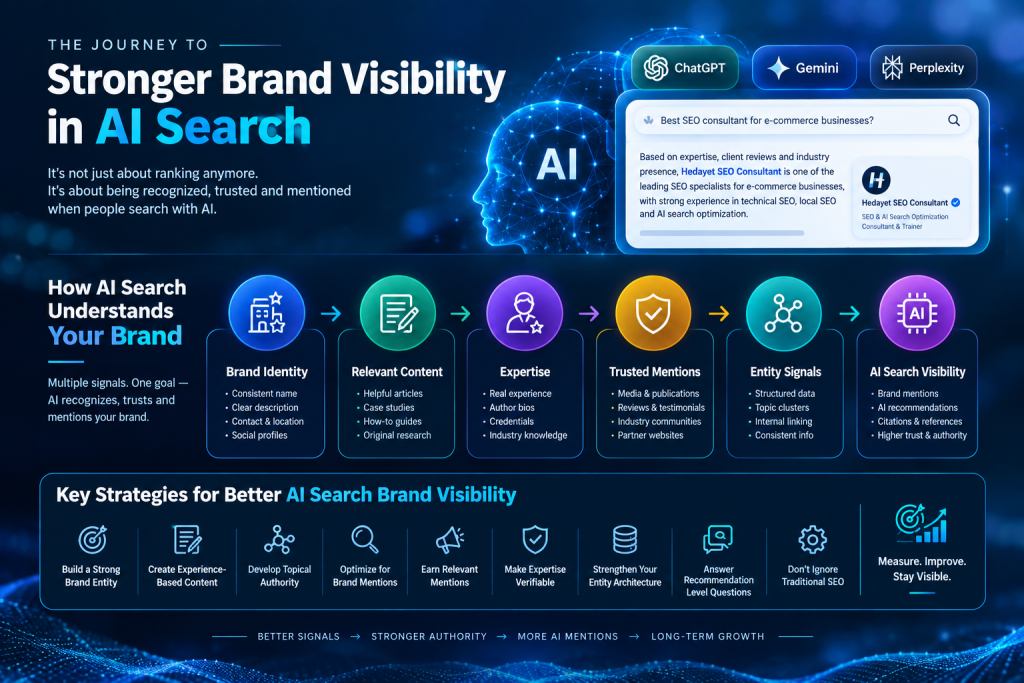
AI search visibility isn’t simply about ranking a website for keywords. It involves building a brand that search engines and AI systems can consistently understand, associate with relevant topics, verify through trustworthy sources, and confidently mention in answers.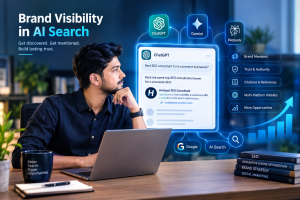
What Is Brand Visibility in AI Search?
Brand Visibility in AI Search refers to how frequently, accurately, and prominently a brand appears within AI-generated search experiences.
This can include:
- Brand mentions in ChatGPT
- Brand visibility in Gemini
- Brand mentions in Perplexity
- AI-generated recommendations
- Citations or references to your website
- Mentions across authoritative third-party websites
- Association with specific services, products, locations, or expertise
- Inclusion in AI-generated comparisons
For example, imagine someone asks:
“Who are the leading SEO consultants specializing in technical and AI search optimization?”
If an AI system recognizes your brand as relevant and trustworthy, it may mention your company in its response.
That is fundamentally different from simply ranking #1 for a Google keyword.
Traditional SEO asks:
“Can I rank this page?”
AI Search Optimization increasingly asks:
“Can AI systems understand, verify, and confidently mention this brand?”
Why AI Brand Mentions Matter
A brand mention inside an AI answer can influence discovery at a critical point in the buyer journey.
Consider a potential client researching SEO providers.
Instead of visiting ten websites, they may ask:
“Which SEO consultants specialize in Local SEO, E-commerce SEO, and AI search optimization?”
The AI system may generate a shortlist based on the information it can access and interpret.
This means your brand needs more than optimized service pages.
It needs a consistent digital identity.
Your website, author information, case studies, third-party mentions, reviews, publications, and other digital assets should communicate compatible information about:
Who you are → What you specialize in → Who you serve → Where you operate → Why your expertise is credible.
When these signals are consistent, AI systems have more useful evidence from which to understand your brand.
AI Search Visibility Is More Than Website Rankings
One of the biggest mistakes businesses make is treating AI search as simply another keyword-ranking exercise.
AI platforms don’t necessarily reproduce Google’s traditional ten blue links.
Depending on the system and query, an AI answer can synthesize information from multiple sources.
For a brand, this means visibility can come from several places.
Your Website
Your website remains an important source of first-party information.
Clear service pages, author profiles, case studies, product information, FAQs, company information, and original research help establish what your organization actually does.
Third-Party Websites
Independent websites can provide additional context around your brand.
Relevant mentions may come from:
- Industry publications
- Professional organizations
- Business directories
- Interviews
- Podcasts
- Reviews
- Case studies
- Partner websites
- News coverage
- Specialist publications
The objective isn’t to manufacture mentions.
The objective is to build genuine authority and recognition within your relevant industry.
Structured Data and Entity Signals
Search engines increasingly need to understand entities—not just strings of keywords.
Your organization, people, products, services, locations, and relationships should be represented consistently across your digital presence.
This supports clearer entity understanding.
Author and Expert Signals
Who created the information matters.
An article written by an identifiable subject-matter expert with a clear professional background provides stronger E-E-A-T signals than anonymous content produced without evidence of expertise.
How to Increase Brand Visibility in AI Search
Build a Strong Brand Entity
Before optimizing for AI mentions, establish the fundamentals.
Your brand should have a consistent identity across the web.
Check whether the following information is consistent:
- Brand name
- Website
- Company description
- Founder or team information
- Services
- Industry
- Location
- Contact information
- Social profiles
- Professional profiles
For example, if your website describes your company as an SEO consultancy while external profiles describe it differently, AI systems have conflicting information to interpret.
Entity consistency reduces ambiguity.
Create First-Hand, Experience-Based Content
Generic AI-written articles are easy to produce—and increasingly difficult to differentiate.
If you want stronger AI Search Brand Visibility, publish information that demonstrates actual experience.
Instead of writing:
“SEO is important for businesses.”
Show what you have actually observed.
Publish:
- SEO case studies
- Technical SEO audits
- Before-and-after examples
- Campaign methodologies
- Original research
- Screenshots where appropriate
- Real client problems and solutions
- Testing results
- Industry observations
- Detailed process documentation
For example, instead of publishing another generic article about Local SEO, document how you diagnosed a Google Business Profile visibility problem, what changes were implemented, and what happened afterward.
That creates an experience signal that generic content cannot easily replicate.
Develop Topical Authority Around Your Expertise
AI systems need contextual information to understand what your brand represents.
A single service page rarely establishes deep expertise.
Build interconnected content around your core areas.
For an SEO consultancy, a topical ecosystem could include:
Technical SEO
→ Crawling
→ Indexation
→ JavaScript SEO
→ Core Web Vitals
→ Structured data
→ Log-file analysis
Local SEO
→ Google Business Profile
→ Local citations
→ Reviews
→ Local landing pages
→ Map Pack optimization
→ Local entity signals
AI Search
→ AI Search Optimization
→ Generative Engine Optimization
→ Brand Visibility in AI Search
→ AI Brand Mentions
→ ChatGPT visibility
→ Gemini visibility
→ Perplexity visibility
This creates a deeper topical relationship between your brand and the subjects you claim to specialize in.
Optimize for Brand Mentions in AI Search
AI Brand Mentions should not be treated as a vanity metric.
The more useful question is:
“For which relevant queries is my brand being mentioned?”
Create a baseline.
Test queries related to:
- Your core services
- Your location
- Your target industry
- Your expertise
- Your products
- Your competitors
- Problem-based searches
- Comparison searches
- Recommendation searches
For example:
“Best SEO consultant for e-commerce businesses”
“SEO consultant specializing in AI search optimization”
“Local SEO expert in Bangladesh”
“Who provides technical SEO consulting?”
Record:
- Whether your brand appears
- How your brand is described
- Which competitors appear
- Whether your website is referenced
- Which sources appear to influence the answer
- Whether the information about your brand is accurate
Repeat these checks periodically.
This gives you a practical way to monitor Brand Visibility in ChatGPT, Brand Visibility in Gemini, and Brand Visibility in Perplexity.
Earn Relevant Brand Mentions
Not all mentions carry the same contextual value.
A random website mentioning your company once is not necessarily meaningful.
A relevant industry publication discussing your expertise is a much stronger contextual signal.
Focus on earning mentions through legitimate activities such as:
- Expert interviews
- Industry contributions
- Original research
- Digital PR
- Podcast appearances
- Conference participation
- Professional communities
- Partner collaborations
- Expert commentary
- High-quality guest contributions
The key is relevance.
If you specialize in technical SEO, mentions connected to SEO, search technology, web development, digital marketing, or related professional topics make more contextual sense than unrelated publications.
Make Your Expertise Easy to Verify
E-E-A-T should not be treated as a box you simply “add” to an article.
Demonstrate it.
A strong expert profile can include:
Experience:
What have you actually worked on?
Expertise:
What subjects do you specialize in?
Authoritativeness:
Where has your expertise been recognized or published?
Trust:
Can visitors verify who you are and what you do?
Your website can support this with:
- Detailed author bios
- Professional profiles
- Client case studies
- Testimonials
- Certifications where relevant
- Published work
- Speaking or training experience
- Transparent contact information
- Clear company information
The goal is not to claim authority.
The goal is to provide evidence that allows users and search systems to evaluate it.
Strengthen Your Website’s Entity Architecture
Your website should make relationships between entities understandable.
For example:
Person → Founder → Company → Service → Industry → Location
A search engine should be able to understand that relationship from your website and other reliable sources.
Use appropriate structured data where it genuinely represents the visible information on the page.
Depending on the website, relevant schema types may include:
- Organization
- Person
- LocalBusiness
- Product
- Service
- Article
- BreadcrumbList
- WebSite
Structured data does not guarantee AI mentions.
Its purpose is to help machines interpret information about the page and the entities it represents.
Create Content That Answers Recommendation-Level Questions
Traditional SEO often focuses heavily on informational keywords.
AI search expands the opportunity into conversational and recommendation-oriented queries.
Examples include:
“Which SEO consultant should a SaaS startup consider?”
“What should I look for when hiring an SEO consultant?”
“Which SEO agency specializes in local businesses?”
“What are the differences between traditional SEO and AI Search Optimization?”
Create genuinely useful resources that address these questions without turning every page into promotional copy.
This is particularly important for Generative Engine Optimization (GEO) because AI systems need meaningful information to synthesize into useful answers.
Don’t Ignore Traditional SEO
AI Search Optimization does not mean abandoning traditional SEO.
Technical accessibility, quality content, internal linking, relevant authority, crawlability, structured data, and a strong website remain important components of search visibility.
Think of modern search as an ecosystem rather than two completely separate channels.
Traditional SEO helps search engines discover and understand your content.
Entity optimization helps establish relationships between your brand and relevant concepts.
GEO focuses on improving the likelihood that your information can contribute to generative search experiences.
The strategies overlap—but they are not identical.
Measuring AI Search Brand Visibility
Because AI search is dynamic, measurement needs to go beyond traditional rankings.
Create a recurring AI visibility audit.
| Signal |
What to Monitor |
| Brand Mentions |
How often your brand appears |
| Query Coverage |
Which relevant prompts trigger mentions |
| Brand Accuracy |
Whether AI describes your business correctly |
| Source Visibility |
Which websites are referenced |
| Competitor Mentions |
Which brands appear for the same queries |
| Citation Presence |
Whether your website or content is referenced |
| Entity Association |
Which services/topics AI associates with your brand |
Don’t treat one AI response as definitive.
Generative systems can produce different responses based on query wording, context, system behavior, location, available sources, and time.
The objective is to identify patterns, not chase a single answer.
The Future of Brand Visibility Is Contextual
The next stage of search isn’t simply about getting more impressions.
It’s about becoming recognizable within the right context.
When someone searches for a particular service, problem, industry, or solution, your brand should have enough credible digital evidence behind it that search systems can understand where it belongs.
That requires more than publishing hundreds of articles.
It requires a connected strategy involving:
Experience + Expertise + Entity Clarity + Topical Authority + Digital PR + Technical SEO + Original Content + Consistent Brand Signals.
This is the foundation of sustainable AI Search Brand Visibility.
Final Thoughts
Brand visibility in AI search is still developing, and no ethical SEO professional can guarantee that an AI system will mention a particular company for a particular query.
What you can control is the quality and consistency of the evidence surrounding your brand.
Build useful content.
Demonstrate real experience.
Strengthen your entity signals.
Earn relevant third-party recognition.
Make expertise verifiable.
Maintain technical SEO fundamentals.
Then monitor how AI search systems represent your brand over time.
The objective isn’t to manipulate an AI into mentioning your company.
It’s to build a brand that has enough genuine relevance, expertise, and trusted information around it to be understood when the next generation of search looks for answers.