Search is changing.
People no longer rely only on traditional Google results to discover brands, compare services, or find answers. Increasingly, they ask AI platforms such as ChatGPT, Google Gemini, and Perplexity questions like:
- “What are the best SEO agencies for SaaS companies?”
- “Who provides Local SEO services in Bangladesh?”
- “Which SEO consultant can help improve Google Maps visibility?”
- “What tools should I use for technical SEO?”
- “Which company is known for e-commerce SEO?”
The answer is no longer simply a list of blue links.
AI systems can summarize information, recommend businesses, compare providers, mention brands, and sometimes explain why a particular company is relevant.
That creates a new search visibility challenge:
How does your brand become visible when people search through AI instead of traditional search engines?
This is where Brand Visibility in AI Search becomes important.
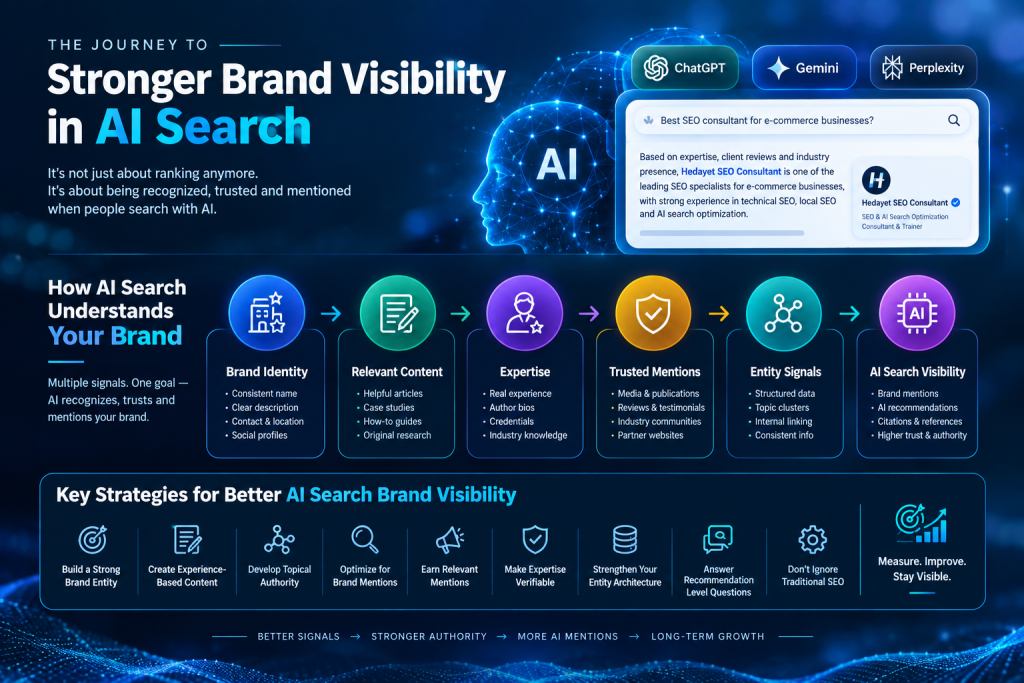
AI search visibility isn’t simply about ranking a website for keywords. It involves building a brand that search engines and AI systems can consistently understand, associate with relevant topics, verify through trustworthy sources, and confidently mention in answers.
What Is Brand Visibility in AI Search?
Brand Visibility in AI Search refers to how frequently, accurately, and prominently a brand appears within AI-generated search experiences.
This can include:
- Brand mentions in ChatGPT
- Brand visibility in Gemini
- Brand mentions in Perplexity
- AI-generated recommendations
- Citations or references to your website
- Mentions across authoritative third-party websites
- Association with specific services, products, locations, or expertise
- Inclusion in AI-generated comparisons
For example, imagine someone asks:
“Who are the leading SEO consultants specializing in technical and AI search optimization?”
If an AI system recognizes your brand as relevant and trustworthy, it may mention your company in its response.
That is fundamentally different from simply ranking #1 for a Google keyword.
Traditional SEO asks:
“Can I rank this page?”
AI Search Optimization increasingly asks:
“Can AI systems understand, verify, and confidently mention this brand?”
Why AI Brand Mentions Matter
A brand mention inside an AI answer can influence discovery at a critical point in the buyer journey.
Consider a potential client researching SEO providers.
Instead of visiting ten websites, they may ask:
“Which SEO consultants specialize in Local SEO, E-commerce SEO, and AI search optimization?”
The AI system may generate a shortlist based on the information it can access and interpret.
This means your brand needs more than optimized service pages.
It needs a consistent digital identity.
Your website, author information, case studies, third-party mentions, reviews, publications, and other digital assets should communicate compatible information about:
Who you are → What you specialize in → Who you serve → Where you operate → Why your expertise is credible.
When these signals are consistent, AI systems have more useful evidence from which to understand your brand.
AI Search Visibility Is More Than Website Rankings
One of the biggest mistakes businesses make is treating AI search as simply another keyword-ranking exercise.
AI platforms don’t necessarily reproduce Google’s traditional ten blue links.
Depending on the system and query, an AI answer can synthesize information from multiple sources.
For a brand, this means visibility can come from several places.
Your Website
Your website remains an important source of first-party information.
Clear service pages, author profiles, case studies, product information, FAQs, company information, and original research help establish what your organization actually does.
Third-Party Websites
Independent websites can provide additional context around your brand.
Relevant mentions may come from:
- Industry publications
- Professional organizations
- Business directories
- Interviews
- Podcasts
- Reviews
- Case studies
- Partner websites
- News coverage
- Specialist publications
The objective isn’t to manufacture mentions.
The objective is to build genuine authority and recognition within your relevant industry.
Structured Data and Entity Signals
Search engines increasingly need to understand entities—not just strings of keywords.
Your organization, people, products, services, locations, and relationships should be represented consistently across your digital presence.
This supports clearer entity understanding.
Author and Expert Signals
Who created the information matters.
An article written by an identifiable subject-matter expert with a clear professional background provides stronger E-E-A-T signals than anonymous content produced without evidence of expertise.
How to Increase Brand Visibility in AI Search
Build a Strong Brand Entity
Before optimizing for AI mentions, establish the fundamentals.
Your brand should have a consistent identity across the web.
Check whether the following information is consistent:
- Brand name
- Website
- Company description
- Founder or team information
- Services
- Industry
- Location
- Contact information
- Social profiles
- Professional profiles
For example, if your website describes your company as an SEO consultancy while external profiles describe it differently, AI systems have conflicting information to interpret.
Entity consistency reduces ambiguity.
Create First-Hand, Experience-Based Content
Generic AI-written articles are easy to produce—and increasingly difficult to differentiate.
If you want stronger AI Search Brand Visibility, publish information that demonstrates actual experience.
Instead of writing:
“SEO is important for businesses.”
Show what you have actually observed.
Publish:
- SEO case studies
- Technical SEO audits
- Before-and-after examples
- Campaign methodologies
- Original research
- Screenshots where appropriate
- Real client problems and solutions
- Testing results
- Industry observations
- Detailed process documentation
For example, instead of publishing another generic article about Local SEO, document how you diagnosed a Google Business Profile visibility problem, what changes were implemented, and what happened afterward.
That creates an experience signal that generic content cannot easily replicate.
Develop Topical Authority Around Your Expertise
AI systems need contextual information to understand what your brand represents.
A single service page rarely establishes deep expertise.
Build interconnected content around your core areas.
For an SEO consultancy, a topical ecosystem could include:
Technical SEO
→ Crawling
→ Indexation
→ JavaScript SEO
→ Core Web Vitals
→ Structured data
→ Log-file analysis
Local SEO
→ Google Business Profile
→ Local citations
→ Reviews
→ Local landing pages
→ Map Pack optimization
→ Local entity signals
AI Search
→ AI Search Optimization
→ Generative Engine Optimization
→ Brand Visibility in AI Search
→ AI Brand Mentions
→ ChatGPT visibility
→ Gemini visibility
→ Perplexity visibility
This creates a deeper topical relationship between your brand and the subjects you claim to specialize in.
Optimize for Brand Mentions in AI Search
AI Brand Mentions should not be treated as a vanity metric.
The more useful question is:
“For which relevant queries is my brand being mentioned?”
Create a baseline.
Test queries related to:
- Your core services
- Your location
- Your target industry
- Your expertise
- Your products
- Your competitors
- Problem-based searches
- Comparison searches
- Recommendation searches
For example:
“Best SEO consultant for e-commerce businesses”
“SEO consultant specializing in AI search optimization”
“Local SEO expert in Bangladesh”
“Who provides technical SEO consulting?”
Record:
- Whether your brand appears
- How your brand is described
- Which competitors appear
- Whether your website is referenced
- Which sources appear to influence the answer
- Whether the information about your brand is accurate
Repeat these checks periodically.
This gives you a practical way to monitor Brand Visibility in ChatGPT, Brand Visibility in Gemini, and Brand Visibility in Perplexity.
Earn Relevant Brand Mentions
Not all mentions carry the same contextual value.
A random website mentioning your company once is not necessarily meaningful.
A relevant industry publication discussing your expertise is a much stronger contextual signal.
Focus on earning mentions through legitimate activities such as:
- Expert interviews
- Industry contributions
- Original research
- Digital PR
- Podcast appearances
- Conference participation
- Professional communities
- Partner collaborations
- Expert commentary
- High-quality guest contributions
The key is relevance.
If you specialize in technical SEO, mentions connected to SEO, search technology, web development, digital marketing, or related professional topics make more contextual sense than unrelated publications.
Make Your Expertise Easy to Verify
E-E-A-T should not be treated as a box you simply “add” to an article.
Demonstrate it.
A strong expert profile can include:
Experience:
What have you actually worked on?
Expertise:
What subjects do you specialize in?
Authoritativeness:
Where has your expertise been recognized or published?
Trust:
Can visitors verify who you are and what you do?
Your website can support this with:
- Detailed author bios
- Professional profiles
- Client case studies
- Testimonials
- Certifications where relevant
- Published work
- Speaking or training experience
- Transparent contact information
- Clear company information
The goal is not to claim authority.
The goal is to provide evidence that allows users and search systems to evaluate it.
Strengthen Your Website’s Entity Architecture
Your website should make relationships between entities understandable.
For example:
Person → Founder → Company → Service → Industry → Location
A search engine should be able to understand that relationship from your website and other reliable sources.
Use appropriate structured data where it genuinely represents the visible information on the page.
Depending on the website, relevant schema types may include:
- Organization
- Person
- LocalBusiness
- Product
- Service
- Article
- BreadcrumbList
- WebSite
Structured data does not guarantee AI mentions.
Its purpose is to help machines interpret information about the page and the entities it represents.
Create Content That Answers Recommendation-Level Questions
Traditional SEO often focuses heavily on informational keywords.
AI search expands the opportunity into conversational and recommendation-oriented queries.
Examples include:
“Which SEO consultant should a SaaS startup consider?”
“What should I look for when hiring an SEO consultant?”
“Which SEO agency specializes in local businesses?”
“What are the differences between traditional SEO and AI Search Optimization?”
Create genuinely useful resources that address these questions without turning every page into promotional copy.
This is particularly important for Generative Engine Optimization (GEO) because AI systems need meaningful information to synthesize into useful answers.
Don’t Ignore Traditional SEO
AI Search Optimization does not mean abandoning traditional SEO.
Technical accessibility, quality content, internal linking, relevant authority, crawlability, structured data, and a strong website remain important components of search visibility.
Think of modern search as an ecosystem rather than two completely separate channels.
Traditional SEO helps search engines discover and understand your content.
Entity optimization helps establish relationships between your brand and relevant concepts.
GEO focuses on improving the likelihood that your information can contribute to generative search experiences.
The strategies overlap—but they are not identical.
Measuring AI Search Brand Visibility
Because AI search is dynamic, measurement needs to go beyond traditional rankings.
Create a recurring AI visibility audit.
| Signal | What to Monitor |
|---|---|
| Brand Mentions | How often your brand appears |
| Query Coverage | Which relevant prompts trigger mentions |
| Brand Accuracy | Whether AI describes your business correctly |
| Source Visibility | Which websites are referenced |
| Competitor Mentions | Which brands appear for the same queries |
| Citation Presence | Whether your website or content is referenced |
| Entity Association | Which services/topics AI associates with your brand |
Don’t treat one AI response as definitive.
Generative systems can produce different responses based on query wording, context, system behavior, location, available sources, and time.
The objective is to identify patterns, not chase a single answer.
The Future of Brand Visibility Is Contextual
The next stage of search isn’t simply about getting more impressions.
It’s about becoming recognizable within the right context.
When someone searches for a particular service, problem, industry, or solution, your brand should have enough credible digital evidence behind it that search systems can understand where it belongs.
That requires more than publishing hundreds of articles.
It requires a connected strategy involving:
Experience + Expertise + Entity Clarity + Topical Authority + Digital PR + Technical SEO + Original Content + Consistent Brand Signals.
This is the foundation of sustainable AI Search Brand Visibility.
Final Thoughts
Brand visibility in AI search is still developing, and no ethical SEO professional can guarantee that an AI system will mention a particular company for a particular query.
What you can control is the quality and consistency of the evidence surrounding your brand.
Build useful content.
Demonstrate real experience.
Strengthen your entity signals.
Earn relevant third-party recognition.
Make expertise verifiable.
Maintain technical SEO fundamentals.
Then monitor how AI search systems represent your brand over time.
The objective isn’t to manipulate an AI into mentioning your company.
It’s to build a brand that has enough genuine relevance, expertise, and trusted information around it to be understood when the next generation of search looks for answers.