Search engine optimization is no longer only about keywords, backlinks, technical optimization, and search volume. Modern search systems are increasingly focused on whether content is genuinely useful, reliable, original, and created by people or organizations that understand the subject.
This is where E-E-A-T in SEO becomes important.
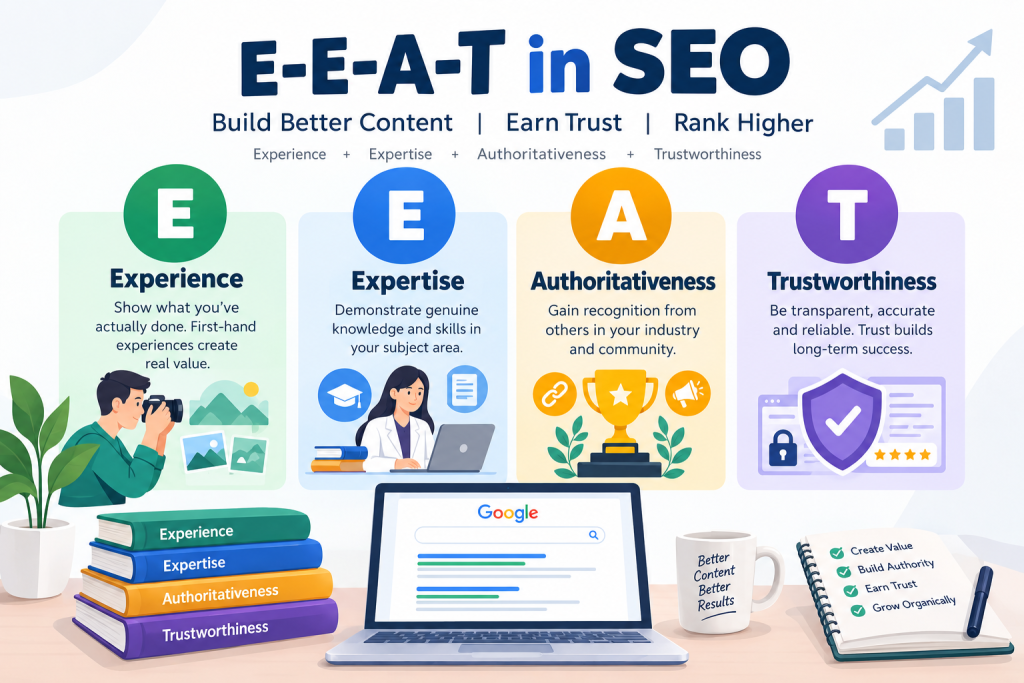
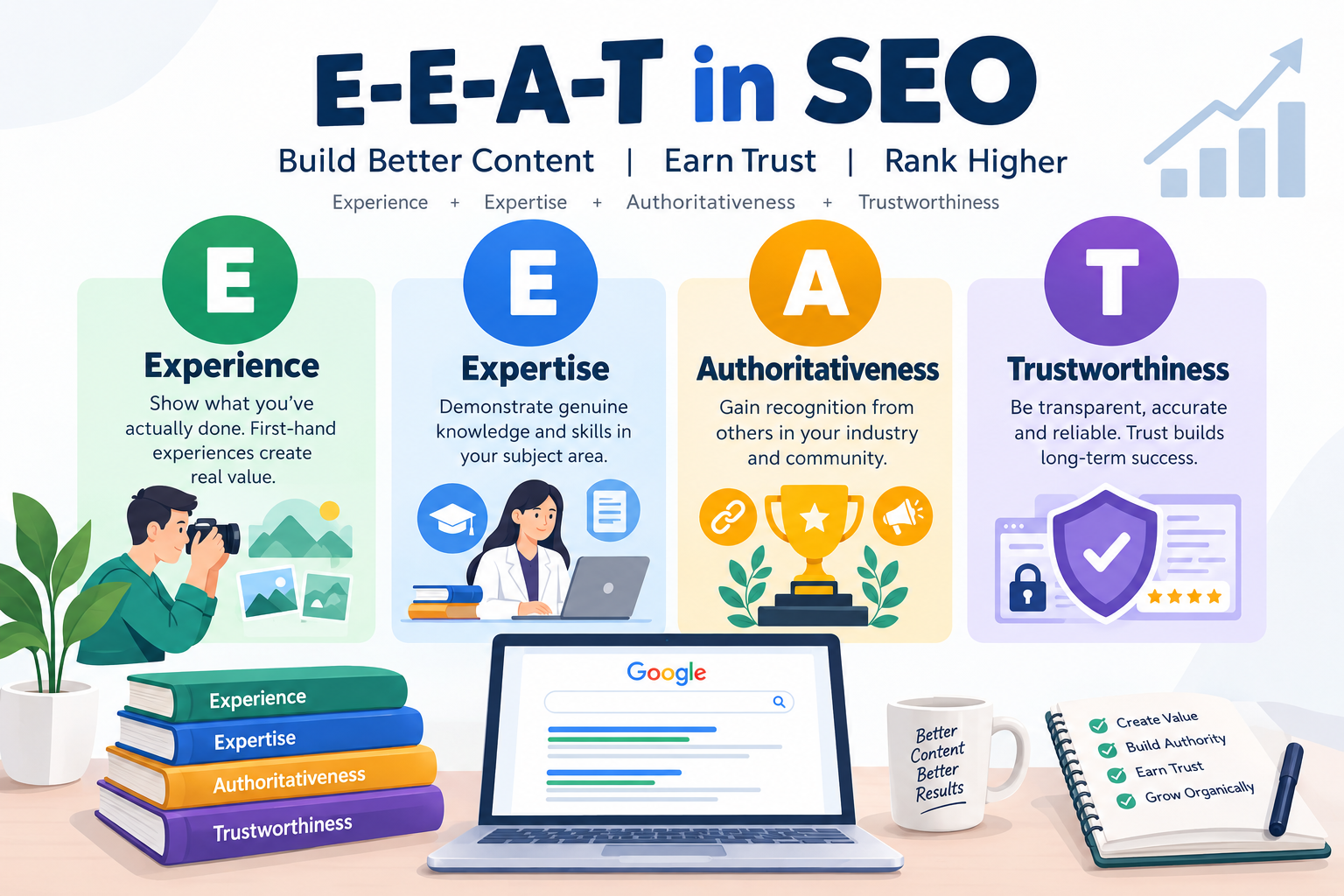
E-E-A-T stands for Experience, Expertise, Authoritativeness, and Trustworthiness. Google introduced the additional “E” for Experience to its quality rater guidelines in 2022, emphasizing the importance of first-hand experience alongside expertise, authority, and trust.
For businesses, bloggers, publishers, ecommerce websites, and SEO professionals, understanding E-E-A-T can help create stronger content and a more credible online presence.
What Is E-E-A-T in SEO?
E-E-A-T in SEO refers to the signals and qualities that help demonstrate that a website, author, business, or piece of content is experienced, knowledgeable, authoritative, and trustworthy.
The four components are:
- Experience – Has the creator actually experienced or used what they are discussing?
- Expertise – Does the creator demonstrate knowledge and skill in the subject?
- Authoritativeness – Is the creator or website recognized as a reliable source?
- Trustworthiness – Can users trust the information, business, website, and claims?
Google’s guidance emphasizes that trust is the most important aspect of E-E-A-T, while the other elements can contribute to establishing that trust.
However, an important distinction is necessary: E-E-A-T itself is not a specific ranking factor. Google uses many signals within its automated systems to identify helpful, reliable content that demonstrates these qualities.
Why Is E-E-A-T Important in SEO?
The internet contains millions of pages covering the same subjects. Simply publishing another article targeting the same keyword is unlikely to create meaningful differentiation.
Google’s systems aim to prioritize helpful and reliable information created primarily for people rather than content produced mainly to manipulate search rankings.
This makes E-E-A-T in SEO particularly valuable for websites competing in crowded search results.
Strong E-E-A-T can help a website demonstrate:
- Real-world knowledge
- Subject-matter expertise
- Brand credibility
- Author credibility
- Reliable information
- Original insights
- Transparent business information
- Better user confidence
For sensitive topics involving health, finances, safety, or major life decisions, Google places even greater importance on strong E-E-A-T signals. These topics are commonly referred to as YMYL — Your Money or Your Life.
The Four Elements of E-E-A-T 
1. Experience
Experience is the first “E” in E-E-A-T.
It focuses on whether content demonstrates first-hand or practical experience with the topic.
For example, imagine someone writes:
“I tested five SEO tools for six months and compared their keyword databases, reporting features, and workflow.”
That type of content can demonstrate experience because the creator is describing actual usage rather than simply repeating information from other websites.
Experience can be demonstrated through:
- Original case studies
- Product testing
- Personal experiments
- Before-and-after results
- Original photographs
- Screenshots
- Project examples
- Customer experiences
- First-hand reviews
- Practical tutorials
Google specifically gives examples such as actually using a product, visiting a place, or communicating personal experience as ways content can demonstrate experience.
2. Expertise
Expertise refers to the depth of knowledge demonstrated by the content creator.
An expert doesn’t necessarily need to have a formal degree for every topic. The appropriate level of expertise depends on the subject and the type of information being provided.
For example, an experienced SEO professional may demonstrate expertise through:
- Years of practical SEO work
- Technical SEO projects
- Keyword research experience
- Successful SEO campaigns
- Detailed case studies
- Industry certifications
- Publications
- Educational resources
- Conference appearances
- Professional profiles
Google recommends making it clear who created content and providing relevant information about the author when appropriate. Author bylines and links to author information can help users understand the creator’s background.
3. Authoritativeness
Authoritativeness is about recognition.
A website may demonstrate authority when other credible websites, organizations, professionals, or communities recognize it as a valuable source.
Authority can develop through:
- High-quality backlinks
- Industry mentions
- Digital PR
- Expert contributions
- Citations
- Original research
- Strong author profiles
- Brand recognition
- Consistent topical coverage
- Professional achievements
Authority is not created overnight. It usually develops through consistently publishing valuable information and becoming known for a particular subject.
This is why topical authority and E-E-A-T often work well together in a long-term SEO strategy.
4. Trustworthiness
Trust is the foundation of E-E-A-T.
A website can have knowledgeable authors and strong backlinks, but if visitors cannot trust the business or information, the overall experience becomes weaker.
Trust can be strengthened through:
- Accurate information
- Clear author identification
- Contact information
- About Us pages
- Privacy policies
- Terms and conditions
- Secure HTTPS
- Transparent business details
- Accurate product information
- Genuine customer reviews
- Clear sourcing
- Editorial policies
- Corrections when mistakes occur
Google’s guidance specifically encourages creators to think about who created the content, how it was created, and why it was created. The “why” should primarily be to help people.
How to Improve E-E-A-T in SEO
Improving E-E-A-T in SEO requires more than adding an author name to an article. You need to build credibility across your content, website, brand, and online presence.
Create Original, People-First Content
Start by creating content that genuinely solves the user’s problem.
Don’t write an article simply because a keyword has high search volume.
Instead, ask:
- What does the user actually need?
- What information is missing from existing results?
- Can I provide first-hand experience?
- Can I add original research?
- Can I show real examples?
- Can I explain the subject better?
Google recommends creating helpful, reliable, people-first content rather than search-engine-first content.
Build Strong Author Pages
Every important article should make it clear who created the content.
An effective author page can include:
- Full name
- Professional role
- Areas of expertise
- Experience
- Qualifications
- Published work
- Social profiles
- Relevant achievements
- Links to other articles
For appropriate content, use clear bylines and connect them to detailed author information.
Publish Case Studies and Original Research
Case studies are one of the strongest ways to demonstrate experience.
Instead of writing:
“SEO can increase organic traffic.”
Show what actually happened.
For example:
Client: Local service business
Initial problem: Low local visibility
Strategy: Technical SEO + Local SEO + content optimization
Implementation: Four months
Outcome: Increased qualified organic traffic and improved local visibility
Real examples provide context that generic SEO articles often lack.
Earn Relevant Authority
Backlinks still matter as part of SEO, but the goal should not be collecting random links.
Focus on earning recognition from relevant and credible sources through:
- Digital PR
- Guest contributions
- Expert quotes
- Original research
- Industry partnerships
- Data studies
- Useful resources
- Community participation
The objective is to become a known source within your topic, not simply a website with a large backlink count.
Strengthen Your Website’s Trust Signals
Your website should make visitors feel confident.
Important trust elements include:
- HTTPS
- Real business information
- Contact details
- About page
- Author information
- Clear policies
- Genuine testimonials
- Transparent pricing where appropriate
- Accurate claims
- Professional design
- Easy navigation
Google also emphasizes the importance of a good overall page experience, including security, mobile usability, Core Web Vitals, and avoiding intrusive experiences.
E-E-A-T and AI-Generated Content
The growth of generative AI has made E-E-A-T even more relevant.
Publishing large quantities of generic content is not a sustainable SEO strategy.
Google’s guidance states that its systems focus on the quality and usefulness of content rather than simply whether humans or AI produced it. However, content should still provide original value and comply with Google’s spam policies.
If AI tools are used during content creation, the final content should be:
- Fact-checked
- Edited by knowledgeable people
- Original
- Useful
- Relevant
- Supported by evidence where appropriate
- Enhanced with real experience
Google’s guidance also encourages creators to consider explaining how content was produced when that information would reasonably matter to readers.
The goal should not be more AI content.
The goal should be better content.
E-E-A-T, SEO and Topical Authority
E-E-A-T works particularly well with topical authority.
Suppose a website wants to become an authority in SEO.
Instead of publishing random articles about hundreds of unrelated topics, it could build comprehensive coverage around:
- Technical SEO
- Local SEO
- Ecommerce SEO
- Keyword research
- On-page SEO
- Off-page SEO
- Google Search Console
- Structured data
- Content optimization
- AI search optimization
The website can then demonstrate knowledge across connected subtopics.
This creates a stronger topical ecosystem and gives users multiple useful resources to explore.
Google’s people-first guidance recommends having a clear primary purpose or focus for a website and demonstrating first-hand expertise and depth of knowledge.
E-E-A-T for Local SEO
Local businesses should also pay attention to E-E-A-T in SEO.
A local business can demonstrate trust and experience through:
- Accurate business information
- Real photographs
- Genuine customer reviews
- Detailed service pages
- Local case studies
- Staff information
- About page
- Google Business Profile
- Local citations
- Community involvement
- Consistent business information
Don’t manufacture reviews or create fake claims.
Google’s structured-data guidance also warns against fake or undisclosed incentivized reviews.
Authenticity matters more than volume.
E-E-A-T for Ecommerce SEO
For ecommerce websites, trust can directly influence whether users feel comfortable purchasing.
Strong ecommerce E-E-A-T can include:
- Detailed product descriptions
- Original product photography
- Accurate specifications
- Shipping information
- Return policies
- Secure checkout
- Customer reviews
- Product comparisons
- First-hand testing
- Expert recommendations
- Transparent company information
For product reviews, Google recommends content based on in-depth research and original analysis rather than thin summaries.
Technical SEO and E-E-A-T
E-E-A-T is primarily about content and credibility, but technical SEO creates the foundation that allows users and search engines to access and understand that content.
Important technical areas include:
- Crawlability
- Indexability
- HTTPS
- Mobile usability
- Internal linking
- XML sitemaps
- Canonical URLs
- Structured data
- Page speed
- Core Web Vitals
- Clear site architecture
Structured data can also help Google understand specific information on a page, although adding structured data does not automatically create authority or guarantee rankings.
How to Measure E-E-A-T
There is no universal “E-E-A-T score” in Google Search Console.
Instead, evaluate your website using practical questions.
Experience Checklist
- Do we demonstrate first-hand knowledge?
- Do we show original examples?
- Do we publish case studies?
- Are our reviews based on actual usage?
Expertise Checklist
- Are authors qualified or experienced?
- Are author profiles available?
- Is the information accurate?
- Are important claims supported?
Authority Checklist
- Do credible websites mention us?
- Are we recognized within our industry?
- Do we publish original research?
- Are we building topical authority?
Trust Checklist
- Is our business information transparent?
- Can visitors contact us?
- Are our reviews genuine?
- Is our website secure?
- Are claims accurate?
- Are policies easy to find?
Common E-E-A-T Mistakes to Avoid
Keyword Stuffing
Repeating the same keyword excessively doesn’t create expertise or trust.
Use your primary keyword naturally and support it with related terms and useful information.
Fake Expertise
Don’t claim certifications, experience, awards, or achievements that don’t exist.
False claims can damage trust.
Generic AI Content
AI-assisted content that simply repeats information already available across the web may provide little additional value.
Add original insights, experience, data, examples, and expert review.
Anonymous Content
For topics where authorship matters, hiding who created the content can make it harder for readers to evaluate credibility.
Fake Reviews
Never create fictional customer experiences simply to improve trust or conversions.
Authentic reviews are far more valuable.
E-E-A-T SEO Strategy for 2026
In 2026, a strong SEO strategy should go beyond traditional keyword targeting.
A practical E-E-A-T-focused framework is:
Step 1: Identify your primary topic and audience.
Step 2: Define the experts and experienced contributors behind your content.
Step 3: Build topic clusters around your core subject.
Step 4: Add first-hand insights, examples, data, and case studies.
Step 5: Create strong author and About pages.
Step 6: Improve technical SEO and page experience.
Step 7: Earn relevant mentions and authoritative links.
Step 8: Build genuine reviews and reputation.
Step 9: Update outdated information when necessary.
Step 10: Measure organic visibility, engagement, conversions, and brand growth.
This approach also aligns with Google’s current guidance for creating useful, original content for both traditional search and generative search experiences. Google specifically recommends unique, valuable, non-commodity content and emphasizes first-hand perspectives as a way to provide something beyond information that can easily be reproduced elsewhere.
The Future of E-E-A-T in SEO
Search is changing rapidly.
Users are increasingly discovering information through traditional search results, AI-generated search experiences, videos, social platforms, forums, and other digital channels.
In this environment, simply matching keywords may not be enough.
The websites most likely to stand out are those that can demonstrate:
Real experience + genuine expertise + recognized authority + strong trust.
That is the real value of E-E-A-T in SEO.
Your website should not simply tell people that you are an expert. It should provide evidence that makes the claim believable.
Final Thoughts
E-E-A-T in SEO is not about finding a single ranking trick.
It is about building a website, brand, and content ecosystem that people can genuinely trust.
Experience shows that you have done the work. Expertise shows that you understand the subject. Authoritativeness demonstrates recognition from others. Trustworthiness gives users confidence in what you publish.
Together, these principles create a stronger foundation for sustainable SEO.
If your goal is long-term organic visibility, don’t ask only:
“How can I rank this page?”
Ask a better question:
“Why should Google and users trust this page?”
That shift—from ranking-focused content to trustworthy, people-first content—is at the heart of modern SEO.
E-E-A-T in SEO Quick Takeaways
- Experience: Show what you have actually done.
- Expertise: Demonstrate genuine knowledge.
- Authoritativeness: Build recognition within your industry.
- Trustworthiness: Make your website and information reliable.
- Originality: Add insights that cannot be found everywhere.
- Transparency: Clearly identify authors, businesses, and sources.
- People-first content: Create content to help users, not simply to attract search traffic.
Frequently Asked Questions About E-E-A-T
Is E-E-A-T a Google ranking factor?
No. Google states that E-E-A-T itself is not a specific ranking factor. Instead, Google’s systems use a variety of signals that can identify content demonstrating strong E-E-A-T.
What does E-E-A-T stand for?
E-E-A-T stands for Experience, Expertise, Authoritativeness, and Trustworthiness.
Why is Experience included in E-E-A-T?
Google added Experience to emphasize the value of first-hand knowledge, such as actually using a product